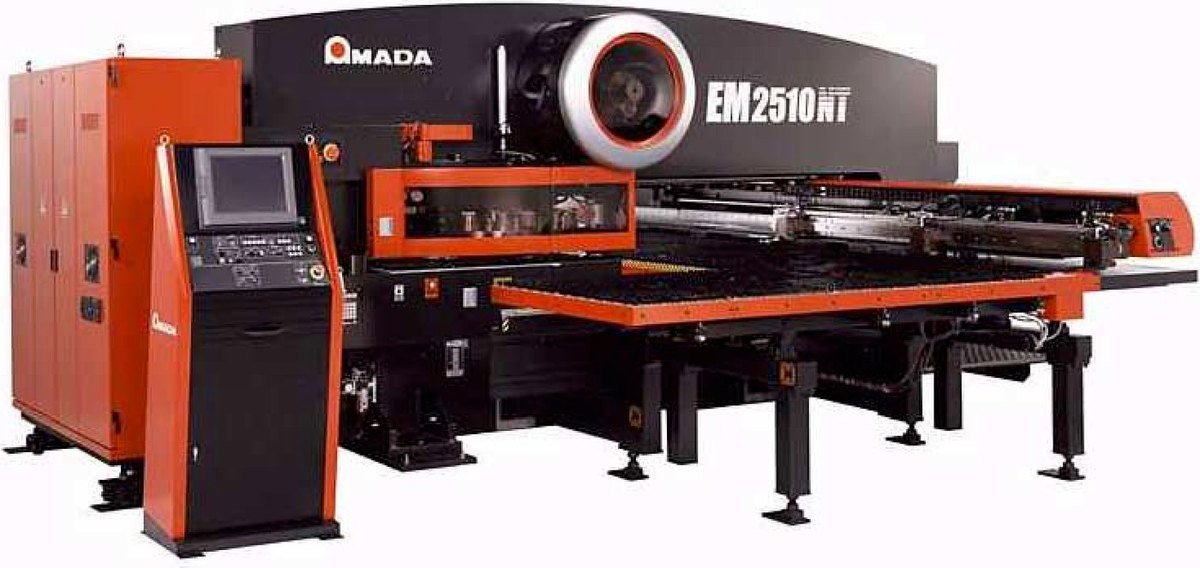
Amada EM-2510 at a glance
- Era
- 2003
- Tonnage
- 22 ton
- Stations
- 45
- Turret
- Thick turret
- Auto-Index
- 4 A/I
- Control
- Fanuc 18i
The EM family has been in production since 2003 and continues today. These are current machines, and turret wear on them is a function of utilisation rather than age.
Where this machine is in its life
An EM-2510 from 2003 sits in the sweet spot for restoration. It is old enough to have accumulated real turret wear, and modern enough that the rest of the machine has plenty of working life in it. Nothing about its capability has been superseded for most sheet metal work.
Shops running these machines are usually not looking to replace them — they are looking to stop scrapping parts.
How an EM-2510 turret wears
At 22 tons, the EM-2510 is a lighter, faster machine, and its turret wear pattern reflects that. wear accumulates through sheer cycle volume rather than force per hit. A high-throughput shop can put more hits through a 22-ton machine in a year than a heavy press sees in five.
With 45 stations, an EM-2510 turret usually shows wear concentrated in the positions running the most common tooling. Sleeving does not have to be all-or-nothing — the worn stations are done and the rest are left as they are.
The tell is always the same: the fault stays with the station rather than following the tool. Move a tool that is producing bad parts to another station — if it runs clean there, the bore is worn, and new tooling will not change that. See holes out of round, burring on punched parts or punches dulling too fast for the full diagnosis.
What sleeving an EM-2510 involves
Each worn bore is machined to a precise oversize and a hardened USA-made steel sleeve is installed with a precision slip fit and secured with retaining compound, restoring the station to Amada factory tolerance — typically within 0.0002″. Engineers travel to you; the EM-2510 never ships. 2–3 days of downtime, typically $8,000–$25,000 depending on scope. After the first install your own maintenance staff can replace sleeves in future.
Set against $100,000–$500,000+ for a replacement machine — see sleeve or replace, including where replacing genuinely wins.
4 A/I on this machine
The EM-2510 carries 4 auto-index stations of its 45 — two 1¼″ and two 2″. Auto-index stations rotate tooling in 0.01° increments through gears, bearings and a rotary encoder mechanism — all in constant motion, all wearing. Symptoms are angular drift, indexing errors, alarm codes and parts punched off-angle.
TSI rebuilds them completely and calibrates before sign-off, routinely in the same visit as sleeving. Auto-index refurbishment · diagnosing angle errors.
Is the EM-2510 a thick or thin turret machine?
The EM-2510 is a thick turret machine. Thick and thin describe the turret, not automatically the tooling — the two are quoted separately, and a machine has to be identified on both counts before sleeves or tooling are ordered.
Tonnage will not tell you either: several 22-ton Amada machines run thick turrets. If you are not certain what your press carries, send us the model and serial number and we will confirm it. See also thick vs thin turret and how Amada model numbers work.
How the EM-2510 compares
Original EM servo electric — that is what sets this machine apart on the spec sheet.
These machines are easy to mix up, and the difference matters when you are quoting a turret job. Against the other EM models we cover:
- Amada EMK-3610NT — stations 58 · tonnage 33 ton · control AMNC-F PC.
- Amada EMK-3612 M2 — stations 55, 58, 67 or 70 · auto-index 4 A/I on the 55 and 58; 2 A/I on the 67 and 70 · tonnage 33 ton.
- Amada EMK-3510NT — stations 58 · auto-index 4 A/I · tonnage 33 ton.
- Amada EMZ-3610NT — stations 45-70 · auto-index 2/4 A/I · tonnage 33 ton.
- Amada EM 3612 ZRTe — stations 32, 36 or 40 · auto-index 4 A/I on the 32-station turret; 2 on the 36 and 40 · tonnage 30 ton.
- Amada EMZ-3510NT — stations 45-70 · auto-index 2/4 A/I · tonnage 33 ton.
- Amada EMK-3510 M2 — stations 55, 58, 67 or 70 · auto-index 4 A/I on the 55 and 58; 2 A/I on the 67 and 70 · tonnage 33 ton.
- Amada EM-2510NT — stations 45 or 58 · auto-index 4 A/I on the 45-station turret; 2 on the 58 · tonnage 22 ton.
- Amada EM-2510 MII — stations 44/4AI, 45/4AI, 49/2AI or 58/2AI · auto-index 2 or 4, per configuration · tonnage 22 ton.
- Amada EM-2612 MII — stations 44/4AI, 45/4AI, 49/2AI or 58/2AI · auto-index 2 or 4, per configuration · tonnage 22 ton.
- Amada EML-3610NT — stations 58 · tonnage 33 ton · control Fanuc AMNC NT.
- Amada EMLK-3610NT — stations 58 King · tonnage 33 ton · control AMNC NT.
- Amada EM-3510 ZRTe — stations 32 · auto-index 4 A/I · tonnage 30 ton.
- Amada EM-3612 ZRBe — stations 32 · auto-index 4 A/I · tonnage 30 ton.
- Amada EM-3510ZRB — stations 32, 36 or 40 · auto-index 4 A/I on the 32-station turret; 2 on the 36 and 40 · tonnage 30 ton.
Sleeving is the same process across all of them. What changes is scope, and scope follows station count and how hard the machine has been run.
The Fanuc 18i control
The EM-2510 runs the Fanuc 18i. Many are still serviceable and there is no reason to touch a control that is doing its job. It is worth knowing that a FANUC retrofit is available if yours becomes a problem, and that it is far cheaper done alongside turret work than as its own project later.
Amada EM-2510 documentation
Free. The first few downloads need nothing; after that we ask which machine you are working on. Larger parts lists are scanned documents — worth being on Wi-Fi.
Full libraries: manuals and parts lists.
Free estimate on your EM-2510
Model, serial number, and what the machine is doing. We will tell you what it needs — and if it does not need us, we will say so.
Estimates within 12 hours. Typically scheduled within 30 days.
Request an Estimate 📞 +1 435-723-5688Reviewed by Mike Sprehn — Owner, Turret Sleeving International. Mike has been part of turret sleeving from the start and has helped improve both the process and the sleeves themselves. About TSI ›
Last reviewed 2 September 2026