About
Turret Sleeving International
We invented turret sleeving. Thirty-five years and more than 150,000 sleeves later, we are still the ones doing it.
By Steve Durfee, co-founder
Where the sleeve came from
In 1990 we had a method for taking the slop out of a worn Amada or Wiedemann turret. We drilled 3/8″ holes into the worn station bores, pressed in Delrin plugs, and sanded them flush so that just enough plug stood proud of the bore to take up the play that years of punching had worn into it. It worked. Hit-to-hit accuracy came back, tools stopped rocking in the station, and the burring went away. What it lacked was longevity. A plastic plug in a steel bore was never going to outlast the machine.
So the sleeve was born.
The idea came from the diesel shop, not the sheet metal shop. When a diesel truck block wears out, you do not throw the block away. You bore the cylinders oversize and press in a new liner. We saw no reason a turret should be treated any differently. The same boring equipment used to line an engine block, with some modifications of our own, is what we still use to bore a turret station today.
The metal mattered as much as the method. A sleeve has to be hard enough to shrug off a punch guide slamming into it several hundred times a minute, yet stable enough to hold an interference fit in a cast turret for decades. We settled on the alloy only after a good deal of research and consulting with a metallurgist at the University of Utah, my alma mater. With a design in hand and our first run of hardened steel sleeves produced, we flew to Wisconsin and installed our first set. Every station came back to OEM tolerance. We were off and running.
The process started on the Wiedemann. It was the Amada, though, that had the numbers. Amada turrets were everywhere, they all wore in the same places, and nobody had an answer short of a new turret assembly. We followed the work, and Amada became what we do.
A stranger in a flannel shirt
Some years after, I had a booth at a FABTECH show in Chicago. On the second day an older gentleman walked up and started asking questions. Good questions. Specific questions about bore diameters, fits and tool clearances. He was unassuming in his dress, a flannel shirt and a pair of Levi’s, and I answered him the way I would answer anybody who wanted to know how the process worked.
A couple of hours after he left, a salesman from Wilson Tool International came by and asked how I had liked Kenny. I said, Kenny who? It turned out the older gentleman was Kenny Wilson, the owner of Wilson Tool International. Evidently he liked my answers, because he went back to the Wilson Tool booth and told his vice president they needed to fly me out to Wilson Tool to meet with them. His words were:
That was the most beneficial meeting I had in the development of our sleeving process. Kenny and his people helped us pin down the two numbers everything else hangs on: the inside diameter of the turret station and the outside diameter of the tool that runs in it. Get that clearance right and the tool guides true, the punch meets the die square, and the shop stops sharpening tools every other week. Get it wrong and no amount of hardened steel will save you. Kenny Wilson’s help with those dimensions moved us forward more than anything else did, and it carried us from the Wiedemann straight into the Amada work. The salespeople at Wilson Tool have been extremely helpful and very professional ever since.
What’s in a name
Thirty years ago there were a handful of us sleeving turrets. Over the years, one by one, they all ended up here.
Turret Restoration, Inc. was the first name on the door. Daniel Baker owned it, and around 2010 the Turret Restoration Company and turretrestoration.com became ours. Turret Engineering, Inc. was John Teesling’s company. When John passed away, his family approached us, and in 2023 they handed over the rest of his business, the Turret Engineering website and his equipment. We were glad to carry it on for him, and some of that tooling is still in our kits. The Turret Guy and Turret Sleeves both belonged to Gordon Sleeman, and in 2025 we bought them from him.
After several trips to Europe, and after adding Mike Sprehn to the team, we decided to land on one name that said exactly what we do and where we do it: Turret Sleeving International, Inc. It has been our name for a long time now, and it is the only one you need to remember.
Of all the people who started doing turrets thirty years ago, we are the only one still in business. That is not luck. It is what happens when the sleeves hold up and the phone keeps getting answered.
Where the work has taken us
TSI has taken us to every corner of the United States, and we have sleeved Amada turret punch presses in Canada, Mexico, England, Ireland, Scotland, France, Germany, Hungary, Malaysia, Australia and Africa. Twenty-two countries at last count. The turret never ships anywhere. Our field engineers come to your floor with portable boring equipment and a case of sleeves, and most jobs are finished in 2 to 3 days of downtime.
The job itself has not changed much, because it did not need to. We indicate every station and document the wear. Any station reading more than 0.005″ of play gets sleeved. We bore each worn station to a precise oversize, centered and perpendicular to the turret face, clean it, and press in a USA-made hardened steel sleeve with an interference fit. The station is back within Amada OEM tolerance, typically inside 0.0002″, and it stays there.
What we actually do
- Turret sleeving — worn upper turret station bores restored to OEM tolerance, typically within 0.0002″
- Auto-index refurbishment — gears, bearings and rotary mechanisms rebuilt so the station indexes true again
- Complete overhaul — ball screws, LM guide rails, clutch and brake, work holder clamps, plus FANUC control upgrades
- Replacement parts — guide keys, auto-index guides, die holders, lifter springs and collars
Made in the USA
All sleeves are made in the USA and will never be outsourced. The sleeve is the part of this job that has to be right, and it is not somewhere to save money.
TSI today
Mike Sprehn is now the owner of Turret Sleeving International, and he has taken the company to another level in both sales and sleeve design. What goes into an Amada turret today is not what went in back in 1990. The sleeves have been refined job after job, machine after machine, and Mike has driven a good share of that. I am still active in service and development, and I still like watching a dial indicator settle on zero in a station that was rattling an hour before.
The people who worked out how to sleeve an Amada turret are the same company still doing it. This is not a process we bought, licensed or reverse-engineered from somebody else. We started it. We are still doing it. Nobody does it better.
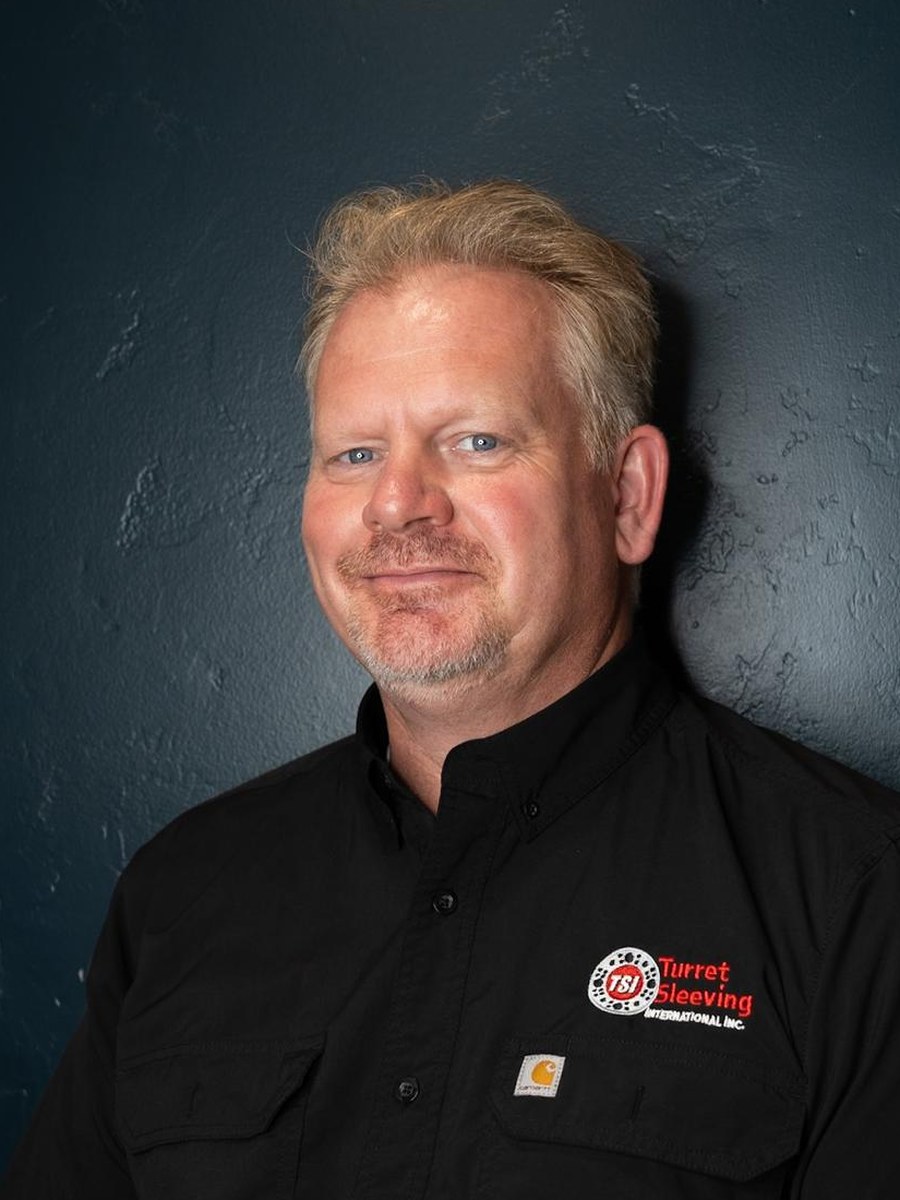
Mike Sprehn
Owner
Mike has been part of turret sleeving from the start, and has spent the years since helping improve both the process and the sleeves themselves. Family-owned and operated since 1990: the same people answer the phone, quote the work and show up to do it.
Mike is who you reach when you call or send a serial plate for a quote. Estimates are free and come back within 12 hours. If you want a straight answer on whether your turret is worth sleeving — including when it is not — ask him directly.
Contact
Turret Sleeving International, Inc.
346 N 1600 W, West Point, UT 84015, USA
+1 435-723-5688 ·
Toll-free (US & Canada) 1-888-686-5900 ·
info@turretsleeving.com