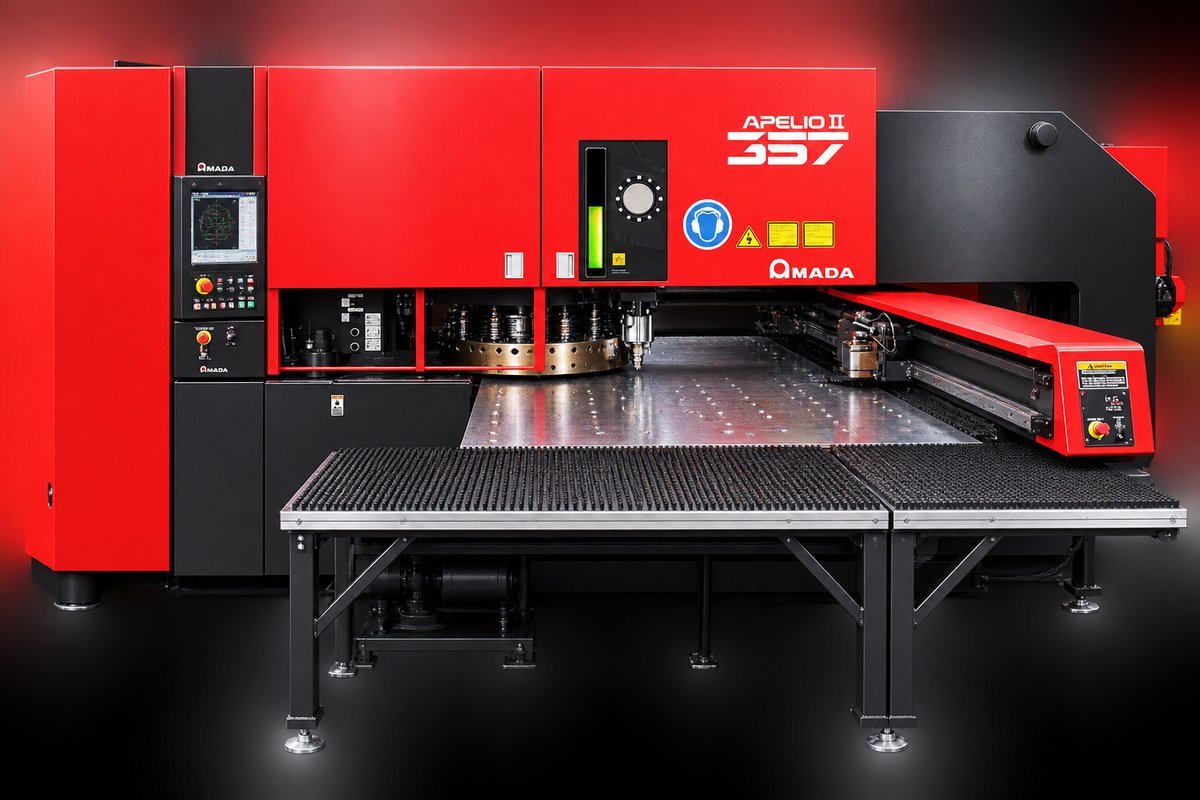
Amada Apelio II 357 at a glance
- Era
- 1992-98
- Tonnage
- 33 ton
- Stations
- 58
- Turret
- Thick turret
- Control
- Fanuc 05PLA
The Apelio line is Amada’s punch-laser combination series, built from the 1990s and long out of production. A combination machine still carries a conventional turret, and those stations wear exactly as they do on a punch press — the laser head changes nothing about the punching side.
Where this machine is in its life
An Apelio II 357 built in 1992-98 has been earning for three decades or more. Machines of this generation are usually fully depreciated, well understood by the people running them, and producing perfectly acceptable work — right up until turret wear starts showing in the parts.
That is the decision point most Punch-Laser Combination owners reach. The mechanical structure of these machines is heavily built and typically still sound; what has aged is the turret bores, and often the control. Neither requires replacing the machine.
How an Apelio II 357 turret wears
At 33 tons, the Apelio II 357 sits in the workhorse band — mixed duty, mixed material, and usually the machine a shop reaches for first. That versatility is also why its turret wears: it runs the widest range of work, and the stations holding the most-used tools take a disproportionate share of the hits.
With 58 stations, work is spread across a wide turret, which is why wear on these machines is so rarely uniform. In practice a handful of stations carry the common tools and wear out well ahead of the rest. Most Apelio II 357 jobs are partial as a result — the worn stations are sleeved and the sound ones are left alone, which keeps both cost and downtime down.
The tell is always the same: the fault stays with the station rather than following the tool. Move a tool that is producing bad parts to another station — if it runs clean there, the bore is worn, and new tooling will not change that. See holes out of round, burring on punched parts or punches dulling too fast for the full diagnosis.
What sleeving an Apelio II 357 involves
Each worn bore is machined to a precise oversize and a hardened USA-made steel sleeve is installed with a precision slip fit and secured with retaining compound, restoring the station to Amada factory tolerance — typically within 0.0002″. Engineers travel to you; the Apelio II 357 never ships. 2–3 days of downtime, typically $8,000–$25,000 depending on scope. After the first install your own maintenance staff can replace sleeves in future.
Set against $100,000–$500,000+ for a replacement machine — see sleeve or replace, including where replacing genuinely wins.
Is the Apelio II 357 a thick or thin turret machine?
The Apelio II 357 is a thick turret machine. Thick and thin describe the turret, not automatically the tooling — the two are quoted separately, and a machine has to be identified on both counts before sleeves or tooling are ordered.
Tonnage will not tell you either: several 22-ton Amada machines run thick turrets. If you are not certain what your press carries, send us the model and serial number and we will confirm it. See also thick vs thin turret and how Amada model numbers work.
What the number tells you
Amada model numbers describe the machine. The Apelio II 357 decodes as a 30-ton class press with a 50 × 70 table — the first digit is tonnage, the other two are table width and length. Its full designation is APELIO-305070.
How to read an Amada model number — useful when your paperwork and your badge disagree.
How the Apelio II 357 compares
These machines are easy to mix up, and the difference matters when you are quoting a turret job. Against the other punch-laser combination models we cover:
- Amada Apelio — stations 58 · tonnage 33 ton · control Fanuc.
- Amada Apelio III 357V — stations 58 · tonnage 33 ton · control Fanuc 16-L.
- Amada Apelio III 367V — stations 58 · tonnage 30 ton · control Fanuc 16-L.
- Amada Apelio III 2510V — stations 58 · tonnage 33 ton · control Fanuc FS-16LB.
- Amada Apelio III 2610V — stations 58 · tonnage 33 ton · control Fanuc 16-L.
- Amada EML-2515 AJ — stations 58 · tonnage 33 ton · control AMNC 3i.
- Amada ACIES 2515T — stations 32/4AI, 36/2AI or 40/2AI · auto-index 2 or 4, per configuration · tonnage 33 ton.
- Amada LC-2515 AJ — stations 58 · tonnage 22 ton · control AMNC NT.
Sleeving is the same process across all of them. What changes is scope, and scope follows station count and how hard the machine has been run.
The Fanuc 05PLA control
An Apelio II 357 of this vintage shipped with the Fanuc 05PLA. If yours is still original, it is very likely the oldest thing on the machine — and the part most likely to strand it, because a control fault on an obsolete system is harder to solve than any mechanical wear.
TSI performs FANUC-based retrofits that keep full programming compatibility, so existing programs continue to run unmodified. Done in the same visit as turret work, it is one shutdown rather than two. See control upgrades.
Free estimate on your Apelio II 357
Model, serial number, and what the machine is doing. We will tell you what it needs — and if it does not need us, we will say so.
Estimates within 12 hours. Typically scheduled within 30 days.
Request an Estimate 📞 +1 435-723-5688Reviewed by Mike Sprehn — Owner, Turret Sleeving International. Mike has been part of turret sleeving from the start and has helped improve both the process and the sleeves themselves. About TSI ›
Last reviewed 2 September 2026